

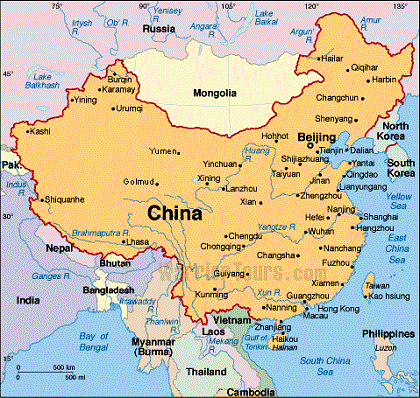
China
Great geographical diversity comprises the large area of land that has for over the last four thousand years, shaped itself into becoming a major world power. As is true for the areas in other continents during the dawn of civilization, gradual progress from generations of people transpired to ultimately provide an incredible modern state of being. When the world moved past the Stone Age and into the discovery of metals, important innovations such as assembling archaic weaponry, agricultural tools, and jewels caused major mobilization of people for the first time in history.
The far-east in China found discoveries in bronze and iron likely around the same time as Europe and Central Asia. Yet its distance from these regions isolated China from major interaction with other parts of the world until much later in time. The developments that came from China therefore were nearly all of their own device but at times struggled to keep pace with the ideas and improvements in living standards that were gaining ground in more integrated regions of the western world.
One key element of China’s isolation in early history was the ability to preserve a unique heritage and avoid influence from encroaching powers of distant lands. The emergence of it’s unique culture and society was a process which emanated almost entirely from the far eastern side of the Chinese continent. To explain this further it’s necessary to understand a little of how China is divided geographically.
The country has always been and still is considered separated between two major areas, Inner and Outer China. The Inner area is that of the eastern coastal stretch from the northern most boundaries of Mongolia all the way south to the populated cities of Beijing and Hong Kong. This mass of land has comprised mostly all of the continent’s population throughout history. The region from the lowest latitude of the Yangtze River to the west across the distant plateaus upon reaching the Himalayas and Hindu Kush has long been considered Outer China. This section represents a minor five percent of the continent’s population and although representing extremely diverse geographic characteristics, rarely has provided an area of human existence. As time proceeded however and the eastern population explored the uninhabited land of Outer China, valuable resources like livestock would be transported back east to Inner China. This had an important part in establishing an improved standard of life for the populated regions yet never resulted in large movements of habitation to the west.
Geographically, the two regions are much different as Outer China is densely wooded and shaped in rugged terrain. Inner China possess a far richer soil which is a result of the loess deposits, a mixture of Gobi Desert sand particles with the ocean moisture most common in the north. Southern Inner China consists largely of the delta region of the Yangtze River which makes its way across much of the continent before dumping into the China Sea in the low lying area where much of the fertile land has been used to supply the country’s annual rice harvest.
The ability for early tribes of people to utilize the main bodies of inland water as resources in farming and travel had a major effect in developing the eastern region’s civilization. The Huang (Yellow) River has served as a primary means of irrigation that later became important in reciprocating trade among the upper Mongolian and Manchurian regions with the southern territory.
The first observable social order of people under an established rule occurred around the second millennia B.C. with the Shang Dynasty. Yu the Great is considered the first Shang emperor, believed to be part of an earlier succession of rulers from above the Huang River down towards the Yangzi Valley in the South. The leaders of the Shang clans were well trained in warfare and hunting using inventive weaponry as a product of the Bronze Age.
A thousand year era of reign for the Shang Dynasty is thought to have occurred at which time the advent of techniques for tomb construction, fortified towns and commerce requiring math and record keeping were part of life. Artifacts representing traces of culture such as decorative clothing, wooden frameworks and musical instruments indicate a component of social cohesion present at that time. 1750 BC can be considered the date for the foundation of the King Tang Dynasty who is seen to have aspired for an improved moral character of the people consisting of less ritualistic practices in favor of more order and obligation.
The King’s importance surpassed just government as he was seen as an intermediary between the human and spirit world much as was the case with Egyptian pharaohs during a similar time period.
As King Tang imposed his power, the Shang civilization continued in its traditions of warfare, hunting, and building settlements. During this era, the emperor would govern with a subordinate rank of family members who oversaw the distant territories but also often relied on local leaders who would in turn cooperate with the named emperor.
By the mid thirteenth century BC, a fatigued military force due to constant fighting among regional clans fostered conditions for an aspiring nearby clan to successfully assert a power grab. The ambitious Wu Zhao successfully led the attack of the Shang leader, Di-Xin that ushered in the beginnings of what would become a long dynastic period of control for the Zhao family.
For the first two hundred years of Zhao power the golden age of good governance and prosperity is said to have taken form. King Wen was said to have ruled with an even hand that provided respect for its people and observance of family duties. The Dynasty would stand to be the longest and highly revered of all the ruling houses in Chinese history. It was not without its setbacks however. Frequent war among area groups along the north-south stretch of territory in Eastern China continued. The Zhao rulers also as an early form of censorship, adopted the practice of destroying written manuscripts that were contrary to the family’s ability to effectively rule. This was likely in regards to the idea of intermediation by the rulers with the spiritual world to empower governance over the people.
A loosening in the grip of Zhao power came about around 770 BC as more distant groups far from the capital began a trend of claiming power for themselves. In response, the capital city was relocated further to the east from where it had been since Shang rule. More accessible weaponry and modernized inventions mitigated the need for reliance on the central armed force to defend its territory. Aristocratic powers then began gaining moderate control over the land that they inhabited.
Over time the inability to effectively rule these factions of local establishments reshaped the nature of eastern China. The Zhao’s hold on power sustained until the emerging local regions were able to exert enough autonomous strength that they could aggressively oppose the central authority. During the roughly thousand and a half years of Shang and Zhao rule, most settlements of people were integrated as functioning subjects of the Dynasty and power was commanded from the northern region of China. Some farther distant groups such as the Nan and Jiang were perceived as enemies mostly to be left alone.
As the formation of the disparate locations continued, a hierarchical order of status and duty became integrated resulting in a recognized divide among territorial states during an era referred to as the ‘Spring and Autumn Period’ which lasted until 481 BC. The affect was a congregation of adjacent boundaries comprised of people who shared similar characteristics and collaborated in aspects of life with similar sense of identity.
Several of these states were recognizably dominant over the others and struggle ensued to claim additional territory. The states in the central Yangzi Valley pressed northward over time sparking tension with many of the surrounding states. The Qi, residing in the far northeast, managed to prosper as a result of an abundance of salt to trade. The Song vied for control in the same area as Qi but eventually relinquished control to the dominant forces of the Chu. In the region farther inland in current day eastern Mongolia was the formidable Qin Provence along the small Wai River. It’s family implemented a mindful rule that defined their leadership and later managed to secure the good faith of the Zhao dynasty who was still officially recognized. The Qin achieved defeats against the Chu as well as clans to the west. Ultimately in what came to be seen as the two dominant states, the Chu and the Jin wrestled for power in wars for over a century with no clear victor. Thus a dual rule emerged that could be asserted militarily if any of the lesser, previously defeated states attempted to reclaim control over the other states. The states that emerged most dominant in the south were the Wu of the lower Yangzi and the Yue farther south.
Around the fifth century BC the ‘Autumn and Springs Period’ drew to a close and what is recognized as a long period of even more barbaric warfare began to ensue.
By the early fifth century BC, the sword came to be a readily available weapon promoting more frequent fighting. For about two hundred and fifty years, in what is known as the ‘Era of Warring States’ battles for state supremacy transpired until late into the third century. This time is said to mark the last age of pre-imperial China. In the last two hundred years BCE despite violence, cities expanded to crowded proportions. Community involvement also progressed involving games, public attractions, and commerce.
The after effects of the five hundred years of contested battles resulted in survival of several of the most established state powers who were the Han, Wei, Chu, Zhao, Yan, Qi, and Qin families. In 221 BC, having secured tight cooperation with the Zhao, the Qin Empire brought together all of the individual powers to once again administer a central rule. For the next two thousand years of the Imperial Age, China would be ruled under various forms of an Empire that often was centrally unified but also experienced periods of fragmentation.
Power shortly lasted under the Qin rule before the Han Dynasty effectively seized control to begin a 400 year period of reorganized reprieve from the political chaos of before.
In can be generalized that in the many centuries to follow, that a common government philosophy existed among the various powers. Clearly defined societal roles were assigned in a structure that sometimes but not always achieved a well functioning system. A staunch aversion to any form of feudalism was understood to be the position that all emperors held over their methods of government. The population carried out many number of duties in each region of Inner China based upon an ability to do so such as serving in the military, civilian jobs and working on farms that were taxed by the Chinese leaders.
The Han rule lasting until 221 AD advanced many important aspects of life including codification of written language, adopting fewer spoken dialects and important spiritual development.
By the end of it’s reign, rival powers had risen to challenge singular family rule and the subsequent Three Kingdom Period began. This represented a divisional split among the Wei who dominated the Huang River Valley, Chu controlling the Yangzi and the Shu presiding over a land locked domain above the Yangzi gorge. Amongst the powers, existed cultural cooperation as this marked the beginning of western arrival of traders traveling the silk road in pursuit of rare textiles. But divisional rifts along military and intratrade existed affecting the reign of the families until the seventh century when the Sui briefly unified rule.
The period of the Sui as the acting overlord of the continent, further solidified what became customary for political centers to be located in the North while the majority of economic prosperity occurred in the south. The Sui expanded the navy, which aside from military campaigns against neighboring islands, facilitated trade from the south to the north along the rivers. A deadly war though against a northern coastal province diminished the Sui authority and the country’s order was sustained with the ascension of the Tang Dynasty in 618.
Their rule was significant lasting until 907 that experienced an era considered to be a golden age of cultural progress. Many historical poets, authors, artists, innovators of medicine and industrial products existed then. Towards the end of the first millennia the population was expanding to over 80 million people and rule was again becoming less manageable under a single emperor. These conditions left society faced with a teeming transformation that would fragment rule to a grand scale. There the core northern area comprised of Zhao, Wei and Hun (fragments of the Jin Dynasty of the fifth century). Joined together with the Qin and Qi that amounted to a large control area.
Accessibility between the predominate north south regions became more integrated through canals and the Yangzi River connecting with the Gan and Poyang Rivers to facilitate flow back and forth. The only navigable integration between the Western expanses in the north was via the Gallery Road, a man made passage roughly permitting mobilization between the areas. To reach the South China from the West required boat travel along the Yangzi gorges. Patterns of exploration westward began around the tenth and eleventh centuries.
New modes of efficiency began to gain steam with animal drawn labor becoming occasionally utilized to improve farming and other respects of progress. Irrigation that was sourced from China's abundant system of rivers became more developed mainly from the Huang (“Yellow”) and Yangtze Rivers.
The first Dynasty to exert control from the far north region of the Inner continent was that of the Mongol(Yuan) Dynasty whose rule began in 1270. Their era originally undertook the construction of the Great Wall intended to provide a barrier to would be hostile invaders from Mongolia or Manchuria. The capital would be relocated to Dadu, present day Beijing where it has remain ever since.
The Ming Dynasty ushered in the more modern definitions of boundaries among the disparate areas such as the Song, Mongol, Han, Qin, Wei and Zhao groups of people. The term provinces or “daos” came into broad use delineating the territories that each of these and other respective groups occupied. That which began with the geographic prominence of the various regions during the Ming Dynasty, would last as a basic formation of regional lines up to modern society.
There were only a few changes under the Manchu Dynasty (Qing) that came to power in 1645. Important to recognize though is that there are too many historical provinces to compactly describe the entire society in general spatial terms during the time.
The political Union of Inner and Outer China didn’t occur until the 18th century which the Qing(Manchu) Dynasty asserted the grandiose claim of the entire territory. But the governing powers of the newly named Republic of China in Beijing didn’t oversee the western lands with nearly the same control as the east. The annexed land was ultimately answerable to the office of Management of the Frontiers who oversaw regional affairs for the Manchu(Qing) dynasty.
Global influence of the major western powers was encroaching into the far east lands that by the late nineteenth century began having a problematic impact on the people’s tolerance for such intervention. The powers of Britain, France, Japan and the United States found reason to exert their diplomatic strong hold upon China which before long deepened resentment by the population leading to movements that would drastically alter the shape of the country.
People of China in the mid nineteenth century were isolated from the substantial industrial advancement that was making strides in the developed European nations and America. But rather under the Qing Dynasty languished on their agricultural economy. The cities of Beijing, Shanghais and Hong Kong were enormously populated hamlets that perpetuated market commerce among the vicinities of street vendors and small family owned business dealing in goods such as textiles, handcrafts of simple utility products.
The discovery of opium early in the nineteenth century had a dramatic negative impact on much of the urban population who took to emulate the imperial persona of leisure in effect skirting ambition by consuming the highly intoxicating and addictive poppy derived narcotic. It is said that by the 1860’s XX billion out of a total rural population of 400 billion frequently used the drug. The British worsened the endemic across China during their arrival as a potential trade partner by commercializing the distribution of opium to China’s citizens.
Britain envisioned China as it did much of the rest of Asia , as an underdeveloped, uncivil vestige of yesteryear that with modern guidance could evolve to become a prosperous society for itself and its benefactor. Other colonial nations including France and the US made modest attempts to help open the Chinese socio-economic state by assembling foreign ambassadors to develop relations with the members in the House of the Qing Dynasty which had been under their own process of national improvement. The naming of the Republic of China in 1840 which called for the east-west unification was an indication to the west that China’s ambition posed both a global opportunity as well as a mild threat given the superiority in numbers of their population. Diplomatic ties thus strengthened between China and the modernist on looking nations during the last several decades of the nineteenth century.
As the influence grew the urban class acquired greater living standards from the import of technology such as electricity, manufacturing and farming equipment that was provided by Europe as a prospering gesture as well as in exchange for large quantities of rice and grain to be transported back to Europe. The urban areas amassed nearly all of the increased wealth, leaving the rural territory which comprised approximately 60% of population lacking of signs of any improvement.
The Dynasty was succumbing to the need for transforming it’s style of rule from an old standard to a new while confronting a new intellectualism. The country had become immersed yet again in a fragmented contest for rule, only this time not only by large land owning patriarchs but more so from the large urban community, groups of rival warlords, and the peasant farmers all of whom held separate ideas on methods of power that should be used to shape the future of China. One philosophy centered on utilizing the decades of British trade presence along with American aid as a prosperous course to transition from autonomy to a rule that would bestow influence upon the people. Empowering the people with involvement in helping to run the government would encourage the cooperation needed in developing a first world nation. On the other hand there were the radical revolutionaries who strongly opposed any interference by foreigners upon the tradition and innate capacity of China to function as a proud idyllic civilization. Meanwhile Japan’s power was surmounting and a fierce attempt of asserting control in China occurred during the invasion of 1920,.. The war that lasted XXX and resulted in xxx deaths.
The authoritative figure who would emerge from such disunion to lead for xxx years under the principles of urban nationalism was Chiang Kai-Sheik. His rule attempted to balance the magnitude of people who differed considerably over governing philosophy by way of either foreign influence or self rule. Maintaining order during an unruly time posed a significant challenge. Kai-Sheik steered in the direction of non intervention by foreigners and consequently, the prosperity that many had foreseen never took hold as the onset of World War even further disrupted China’s advancement.
The nation stagnated for several decades up through the mid 1940’s until a vociferous revolutionary critic from a rural upbringing planted the seeds of reform. Widespread change that held sway over the country for years before the dawn of communism and the subsequent appointment of it’s first dictator Mao Zedong radicalized the sentiment of people that ushered in the communist society. A disgreived population had become intolerant of the lack in progressive improvements under the haphazard reformist agenda of nationalization of Kai-Sheik. He would flee to Taiwan in 1949 and establish a democratic government there, fueling the tension that would prevail as an issue over the sovereignty of the small island country.
China would rather succumb to a very impressionable yet rather short lived rule by Mao Zedong. His ascension to power in 1949 was fomented by the strong popular support of the country side who he insisted would fuel the nation’s rise from it’s current perilous state. The vision that he conveyed to construct was known as the Great Leap Forward which attempted to rapidly propel industrial and agricultural production. By nationalizing all property and output of the country’s people, the purported strategy was to utilize powers of the state to ensure an up most improvement in productivity that would rival other nations.
China then came to represent a worldly communist example similar but at slight odds with the communist system in place in Russia. Other small red countries like North Korea, Cuba, and Vietnam were recipients of the agricultural output of Chinese farmers. Other nations also were trade partners of China’s agriculture on a large scale and the commitment in maintaining that relationship for China became a signal of greatness for Zedong. The devastation in it’s pursuit to continue this path of development was that food scarcity for it’s citizen’s reached a level of severity. Communist leadership didn’t cease exporting the harvests even though needs were far from being met among the people which led to starvation of approximately forty million over ten years. Some of whom were tortured and worked so exhaustively that they would suffer horrible deaths. Environmental conditions were very unfavorable for several years during Mao’s rule where draught exacerbated the ruinous situation. In 1959, Zedong resigned as dictator but remained a part of the surviving communist party until his death in 1965.
A large force of theocratic thinkers came to propose alternate means of government during the fall of Mao. The new emergence was along similar lines as to what fueled the nationalist force under the leadership of Cheng Kai-Sheik but rather than being totally anti-communist, the theocrats favored a slow political transformation to advance strong socio-economic ideals. Considering the atrocity of the previous decade had re-instigated a modern view on how the country needed to operate. Rather than revolutionizing the system, the hope of the intelligentsia, of whom many were engineers from leading state run universities, was to fuse a modern approach with the hard line communist government. Along similar lines of previous thinking since before the turn of the century, they would strive to empower the individuals to work within a less strict society, so that the country may advance to a status of the United States and European super powers.
The country’s biggest asset, it’s large population, would source the labor and skill of government projects akin to Franklin Roosevelt’s New Deal to lead a movement of integration within itself that could stand up to competing nations. The distance that China would need to cover to catch up though would be nearly an insurmountable challenge in the short term.
The theocratic thinkers envisioned expediting domestic production in diverse areas other than just agriculture. The industries they intended to nurture included all types of manufacturing including car, consumer goods, industrial equipment and areas focused on improving infrastructure. The five major cities that comprised about fifty percent of the population would stand to be the focus of the major advancement with road construction, housing projects, and railways that would draw it‘s work force largely from the urban areas. Despite it’s efforts in gaining support, this movement never was able to win support from China’s single party communist system and thus failed to take form.
Deng Xiaoping succeeded Mao as leader. His reluctance to major change was emblematic of the rule that would continue for much of the rest of the century. State run policies were rooted in cautionary transformation, silenced opposition, and curtailment of free thinking as had been the way under Mao’s breed of communism.
The 1960’s therefore continued a resistant path and embodied the ways that had for the past twenty years stifled development because of the suppressed conditions of it‘s people. Tax levies as they had been for two thousand years were being assessed on farmers. These had persistently exhausted the peasant population and at the time of awakening this new vision for the country, the existence tax costs did nothing to turn the tide on the stagnating advancement for the country. Some change began to occur from the opposition movement of the late 1980’s at which time some powerful individuals began taking sides with the activists. Zhao Ziyang, who was a general secretary of the party had expressed some sympathy to the youth movements particularly Tinnamon Square which brought together activists students in central Beijing. Ziyang extended appeasements to stymie the conflict rather than enact the inhumane annihilation of the students which ultimately would be the case when Deng Xiaoping sent tanks and forces to suppress the situation.
Yet the easing of the system’s intolerance of dissent and granting individual freedom would not significantly improve until the twenty first century. China’s recently departed Premier Wen Jiabao who served his ten year appointment in office had a large impact on coping with the humanitarian issues while the country has gained the productive status that had been envisioned a century ago.
The tendency under the present communist regime to allow the province considerable powers in matters of economic and social governance though poses issues as has been seen from the scandal involving the recent governor of the Chongqing province. Despite such instances of abuse, the vast effort by Beijing’s central government and it’s state run offices has enabled China’s rise as a first world, global power. One major initiative that enhanced conditions for much of the country particularly the rural population was the removal of the two thousand year old tax on farming output. Doing so thus provided a far greater opportunity for the millions of family farmers to afford a meaningful cost of living. Additionally 2006 saw major reforms that were enacted by Premier Xi to the tune of 800 billion dollars similar to the stimulus used by in the US to regain control over the economic crisis. The result has helped in implementing adequate infrastructure for 95% of the rural population, supplying electricity, running water, natural gas and communication services for major areas of the country.